Press Kit
Jump to:
SUMMARY
NSF STELLAR Engine
The laser was first theorized and demonstrated by American scientists and engineers, and the NSF STELLAR Engine in the Rochester/Finger Lakes Region of New York aims to help reassert American dominance in the crucial technology. STELLAR (Science, Technology and Engineering for Laser and Laser Applications Research) is intended to bolster laser research and development, education, company creation, manufacturing, and workforce development.
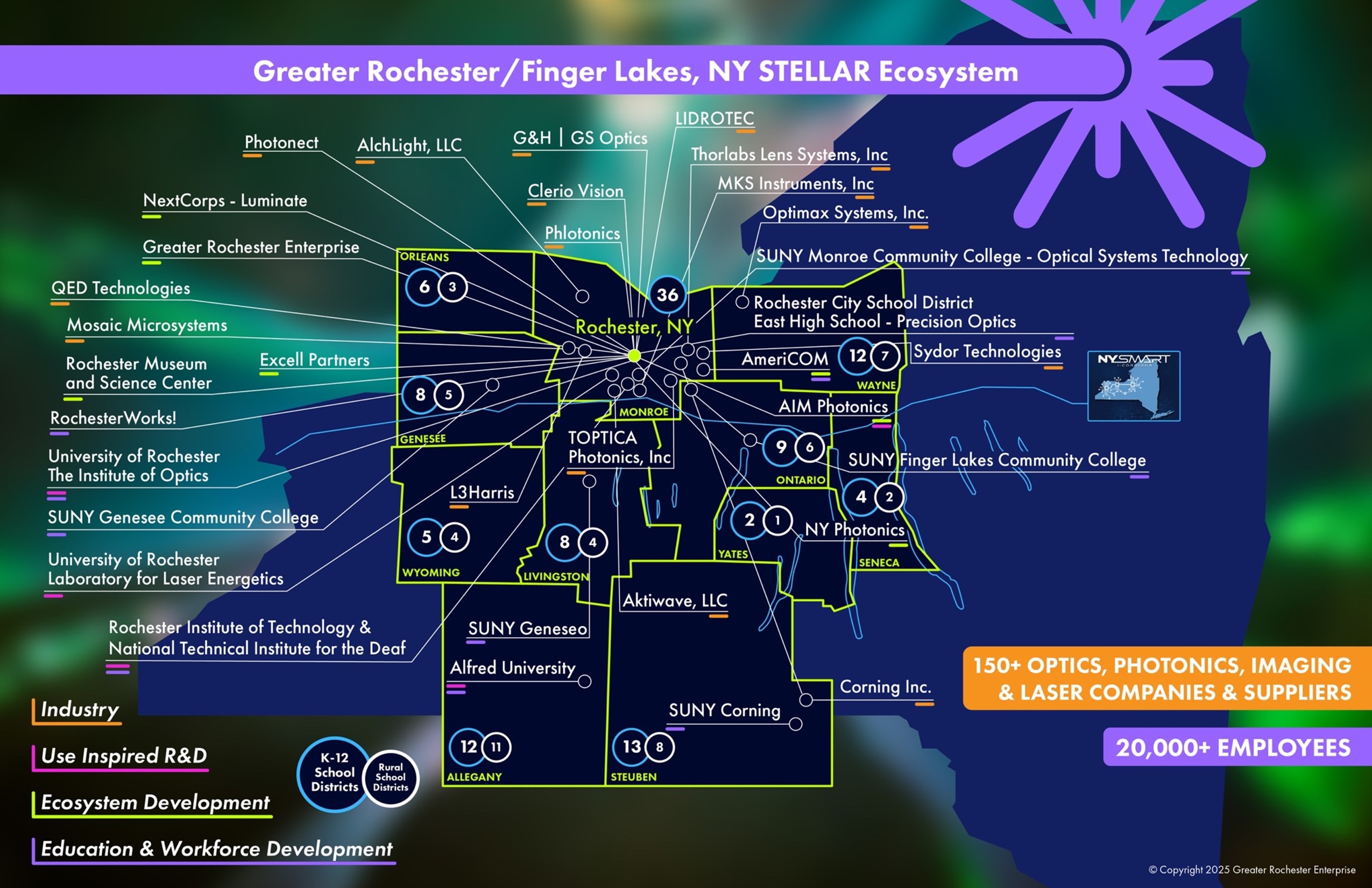
The project builds on a strong foundation, with more than 150 optics, photonics, imaging, and laser supply-chain companies already operating in the Greater Rochester, NY, area. The region houses the University of Rochester’s Laboratory for Laser Energetics, home to the largest—and some of the most powerful—lasers in academia, as well as facilities like the Rochester Institute of Technology’s Semiconductor Nanofabrication Laboratory.
The NSF Engine’s key partners include the University of Rochester’s Institute of Optics and Laboratory for Laser Energetics (LLE), Monroe Community College (MCC), Rochester Institute of Technology (RIT), NextCorps Luminate, Greater Rochester Enterprise (GRE), AmeriCOM, and New York State.
The importance of lasers
An estimated $16 trillion global marketplace depends on lasers for everything from smartphones to national defense.
A technology hub
The Greater Rochester, NY, region is already home to more than 150 optics, photonics, imaging, and laser supply-chain companies.
Education and talent
More than 60% of all optics degrees in the United States are conferred in Rochester, NY.
NSF STELLAR Engine Assets

STELLAR Logo
(light backgrounds)

STELLAR Logo
(dark backgrounds)
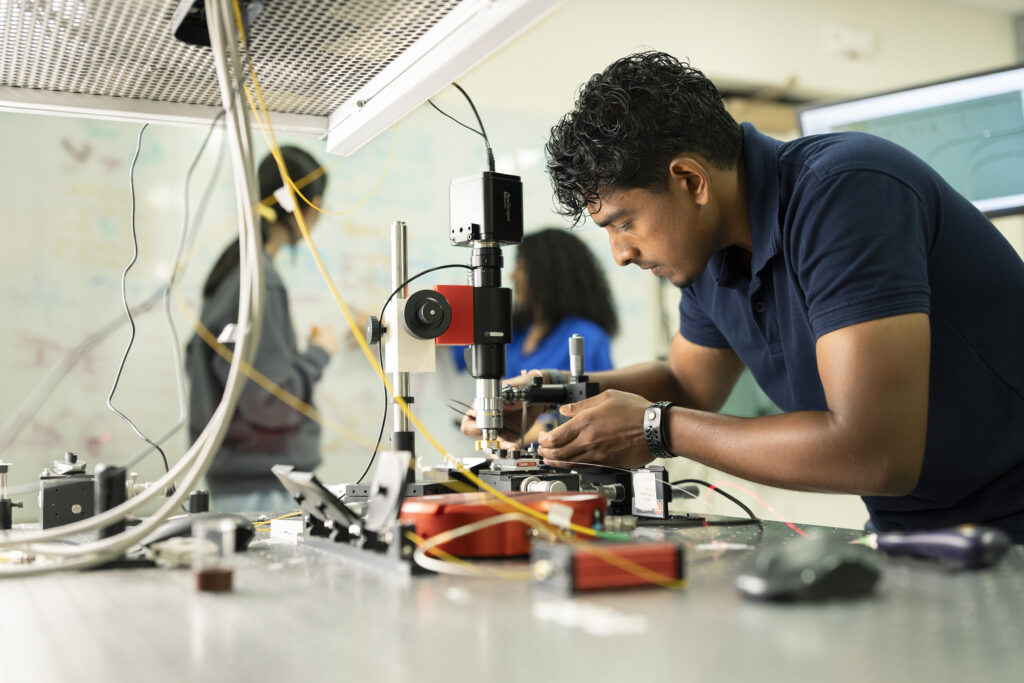
STELLAR Photo 1
Photo Credit:
University of Rochester photo / Grant Taylor
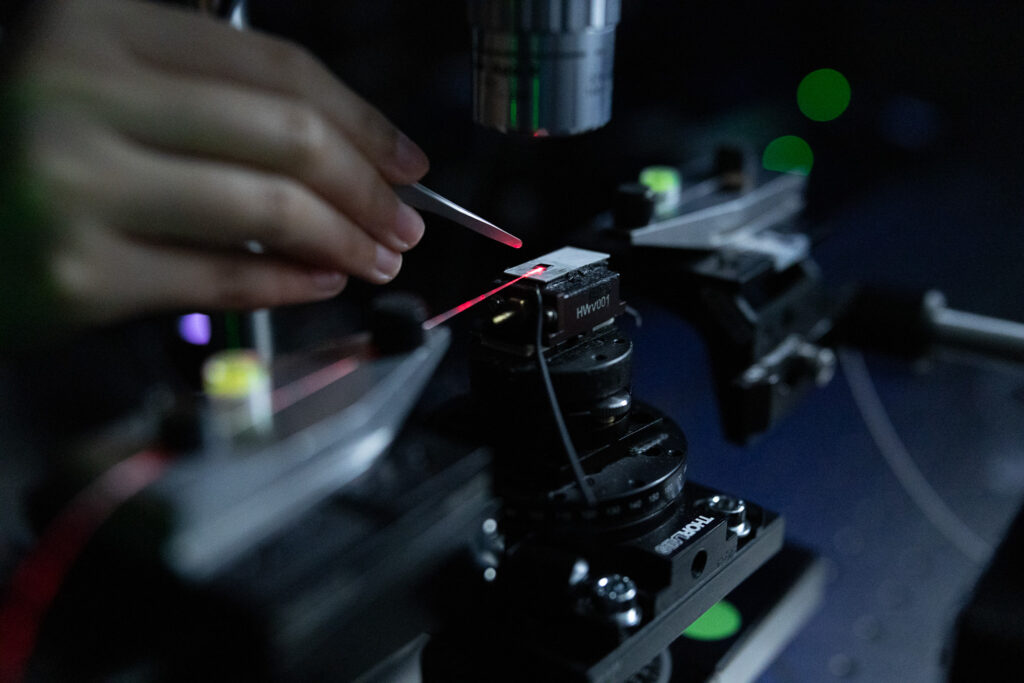
STELLAR Photo 2
Photo Credit:
University of Rochester photo / Grant Taylor
STELLAR Testimonials from Our Collaborators

“The laser industry is expected to experience strong annual growth in he coming years, driven by increasing demand for lasers and photonic components in communications and industrial applications. Against this backdrop, the STELLAR program is expected to strengthen the workforce pipeline and help ensure a steady supply of qualified talent to meet critical R&D and operations needs.”
– Norman Hodgson, CTO, Lasers,
Coherent Corp.

“Through participation in the [NSF] STELLAR Engine, we will further coordinate workforce system activities to meet the increased demand for skilled labor generated by these investments, and ensure that talent pipelines are aligned with industry growth. We will integrate the full menu of services and resources offered through our federally funded One-Stop Career Center and the future NYS-funded One Network for Regional Advanced Manufacturing Partnership (ON-RAMP).”
– Dave Seeley, Executive Director,
RochesterWorks
“There are roughly 25,000 K-12 students in the city limits of Rochester and many more adults. We hope to build on our existing $500,000 conventional precision optical manufacturing lab and become a regional center of laser theory and laser technician education for teenagers during the school year and adults throughout the calendar year.”
– Stephanie Bliss-Walker, Vice Principal,
Rochester City School District
Spokespeople
The NSF STELLAR Engine leadership is happy to connect with members of the media. Visit our Leadership page and expand the ‘Spokesperson Profile’ toggle to learn about each individual’s areas of expertise. Email our media contact below to get in touch with the STELLAR team.
Media Contact
Luke Auburn, University of Rochester
media@stellarlasers.org
Greater Rochester/Finger Lakes, NY STELLAR Ecosystem